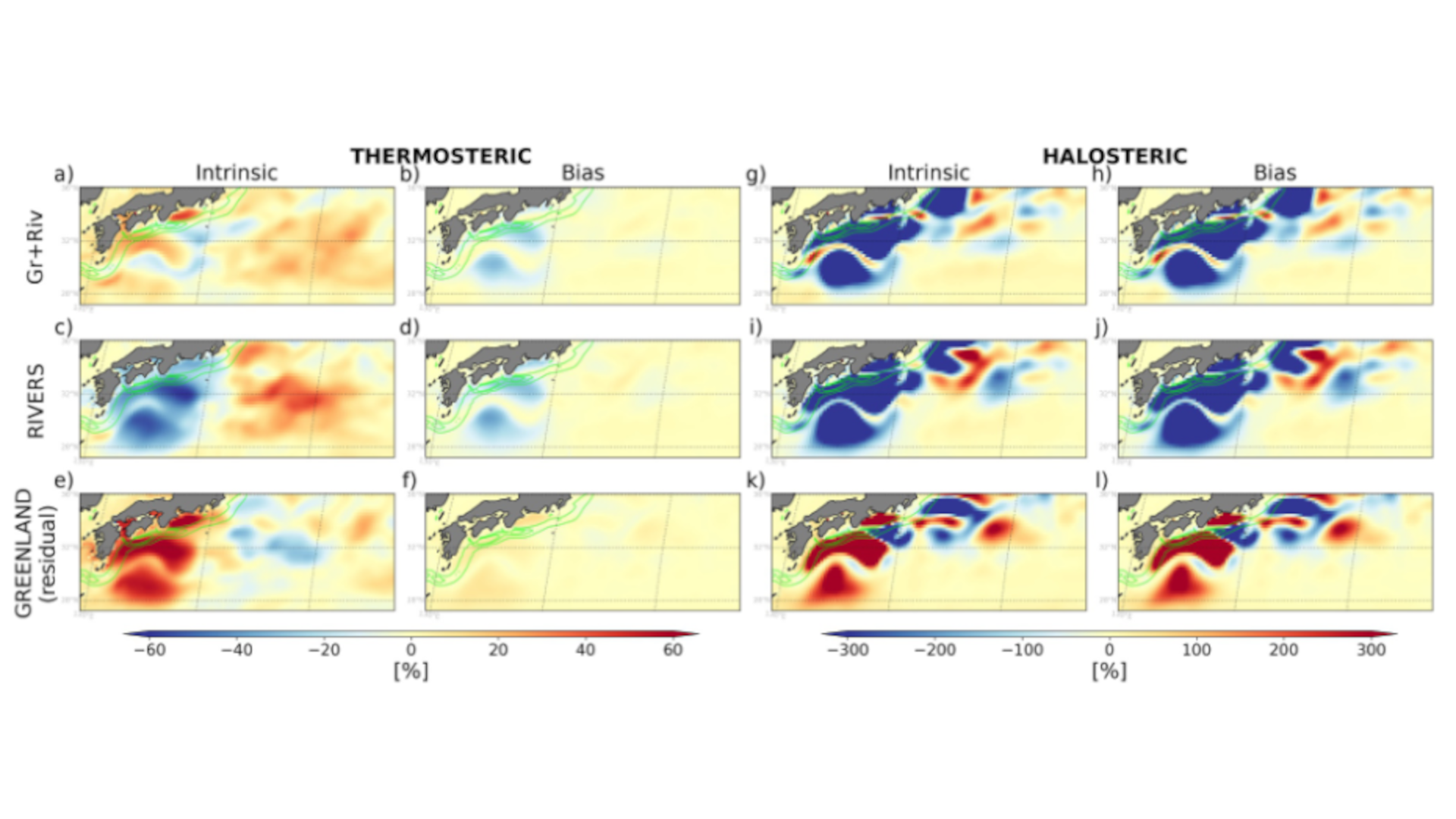
In forced ocean general circulation models (OGCMs), regional sea-level interannual variability arises from internal ocean dynamics and external forcings, among which freshwater fluxes from Greenland and rivers are typically prescribed as a seasonal climatology rather than with their full variability. This study examines the impact of fully time-varying rivers and Greenland fluxes on forced and internal sea-level variability over 1980–2018, using ensemble-based sensitivity experiments of an eddy-permitting OGCM. We introduce an improved, closed ensemble variance decomposition by adding a biased variance term which accounts for ensemble variance in the long-term time mean. The impact of continental freshwater fluxes variability on sea-level variance is highest in the tropical South Atlantic, the maritime continent, and the Kuroshio region. The first two regions are mainly impacted by rivers, primarily through a forced halosteric response, occurring over the full ocean depth in the tropical South Atlantic and mostly over the first 50 m in the maritime continent. In the Kuroshio region, sea-level variance is impacted by both rivers and Greenland through an internally driven response of thermosteric origin. The biased variance enables to correctly evaluate the sources of halosteric sea-level variability in that region as it reveals that its long-term variability is not well resolved by our experiment length. These results emphasize the need for accurately representing time-varying freshwater fluxes in OGCMs to better capture sea-level variability, and the value of the newly closed decomposition for correctly attributing changes in internal variance of any variable, especially in regions of high variability and for short-timescale experiments.