Our researchers are not only presenting, giving keynote talks and convening sessions at EGU26… they're also putting on a show!
Read below for a complete calendar of EERIE participation at the EGU 2026.
Monday, May 4
8:43am-8:53am CEST
DKRZ's Fabian Waschmann will present the Kilometer-Scale Cloud data server (https://km-scale-cloud.dkrz.de) and its underlying software stack Cloudify (https://gitlab.dkrz.de/data-infrastructure-services/cloudify) they've developed and deployed at the German Climate Computing Center. The km-scale cloud provides open and analysis-ready access to prominent climate datasets from projects such as EERIE stored across heterogeneous storage tiers through standardized cloud-native interfaces, without requiring physical data reformatting or migration.
Read on here.
10:45am-12:30pm CEST
Our colleague Eneko Martin-Martinez (BSC) will have his poster A model-based assessment of the climate impacts of the observed AMOC weakening and their sensitivity to model resolution displayed.
More details here.
2:00pm-3:45pm CEST
MPI-M Chathurika Wickramage's poster on Making Kilometer-Scale Earth System Model (ESM) simulations usable: A workflow approach from the EERIE project will be on display.
More about it here.
2:10pm-2:20pm CEST
EERIE scientist Simon Michel (University of Oxford) will give a presentation about the work he's been developing on short- to long-range climate forecasts with deep learning. Existing uncertainty-reduction approaches, including emergent constraints and Bayesian variants, primarily focus on forced climate responses derived from simple aggregate metrics, thereby requiring strong assumptions and exploiting only low-dimensional climate information. Here they propose a data-driven deep-learning framework that directly forecasts spatially and monthly resolved decadal mean climatologies of surface temperature anomalies from the 2030s to the 2090s, using only recent monthly trajectories spanning 1980-2025.
Read more here.
4:15pm-6pm CEST
Our colleague Audrey Delpech (CNRS) will convene the session on Earth system models at km-scale and beyond: Benefits and challenges of resolving smaller scale processes.
The presentations below by Rohit Ghosh, Eneko Martin Martinez and Florian Ziemen are part of this session.
More info can be found here.
4:30pm to 4:40pm CEST
AWI's Rohit Ghosh will present his work on novel century-long global climate simulations at kilometre-scale resolution performed with the coupled IFS–FESOM climate model, featuring a ~9 km atmospheric component and an ocean with a minimum grid spacing of ~5 km. Following the HighResMIP protocol, the experimental design comprises a 50-year high-resolution coupled spin-up, a 65-year historical simulation (1950–2014), a future scenario simulation (SSP2-4.5, 2015–2050), and a 100-year control simulation using fixed 1950 radiative forcing. This framework enables the explicit representation of ocean mesoscale eddies within a long-term global climate context.
Click here for more details.
5:30pm-5:40pm CEST
Eneko Martin-Martinez (BSC) will present his work on North Atlantic response to a quasi-realistic Greenland meltwater forcing in eddy-rich EC-Earth3P-VHR hosing simulations. The vast majority of studies examining the impact of freshwater from ice sheet melting on the Atlantic Meridional Overturning Circulation (AMOC) use climate models that cannot resolve mesoscale ocean processes and do not include an accurate spatio-temporal distribution of the freshwater forcing. These two factors critically affect the nature of the AMOC response. This study fills that gap with a set of three hosing experiments using a perpetual 1950 radiative forcing with the global configurations of the eddy-rich climate model EC-Earth3P-VHR.
Read on here.
5:50pm-6:00pm CEST
DKRZ's Florian Ziemen will be presenting his work on km Scales Hacked at Global Scale.
They enabled the intercomparison by standardizing all datasets to a common HEALPix grid, providing them as cloud-accessible Zarr stores indexed with Intake and deploying a unified Python environment via JupyterHub at the hackathon nodes. This infrastructure avoided the download-and-scan pattern common with large NetCDF collections, enabling faster interactive workflows.
Keep reading here.
Wednesday, May 6
8:55am-9:05am CEST
Our colleague Bianca Mezzina (ECMWF) will give an oral presentation on ENSO teleconnections in eddy-rich climate models. The coupled EERIE simulations show heterogeneous results relative to previous models with coarser grids (maximum 25 km). While the overall performance is positive, it depends on the season, region, and model configuration. Consistent with this, the atmosphere-only experiments suggest only modest gains from enhanced atmospheric resolution. The results are placed in the context of uncertainty in the ENSO response associated with internal variability and sampling, which may hinder potential benefits.
More details here.
4:00pm-5:00pm CEST
Our colleagues with the German Climate Computing Center (DKRZ) will have a show in the exhibition booth #23.
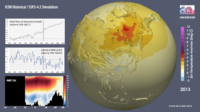
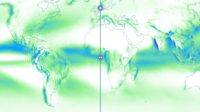
During the first half hour they'll have Fantastic Climate Model Data - a visual journey through simulation output on different grids. Join the tour through the world of climate modeling - we will traverse the triangular-land, jump into an eddy-rich ocean, observe the squaring of the globe and eventually zoom out to 12 pixel.
The second half will focus on Interactive Live Visualization purely in the Webbrowser. Learn how to visualize your Zarr data purely in the Webbrowser on any device by participating in the Gridlook hands-on session. With interactive take-away figures of historical climate states.
Thursday, May 7
11:30-11:50am CEST
EERIE researcher Hannah Christensen (University of Oxford) will give a keynote on Evaluating emergent climate behaviour in a hybrid machine learned atmosphere -- dynamical ocean model. Understanding how fast atmospheric variability shapes slow climate variability and sensitivity is a central challenge in Earth-system science. Recent advances in machine-learned atmospheric models have demonstrated remarkable skill on weather timescales, but their emergent behaviour in a fully coupled climate system is largely unexplored.
Find out more here.
Friday, May 8
8:30am-12:30pm CEST
ECMWF's Bianca Mezzina will be convening a session on Climate predictions from seasonal to multi-decadal timescales and their applications
Find all the details here.