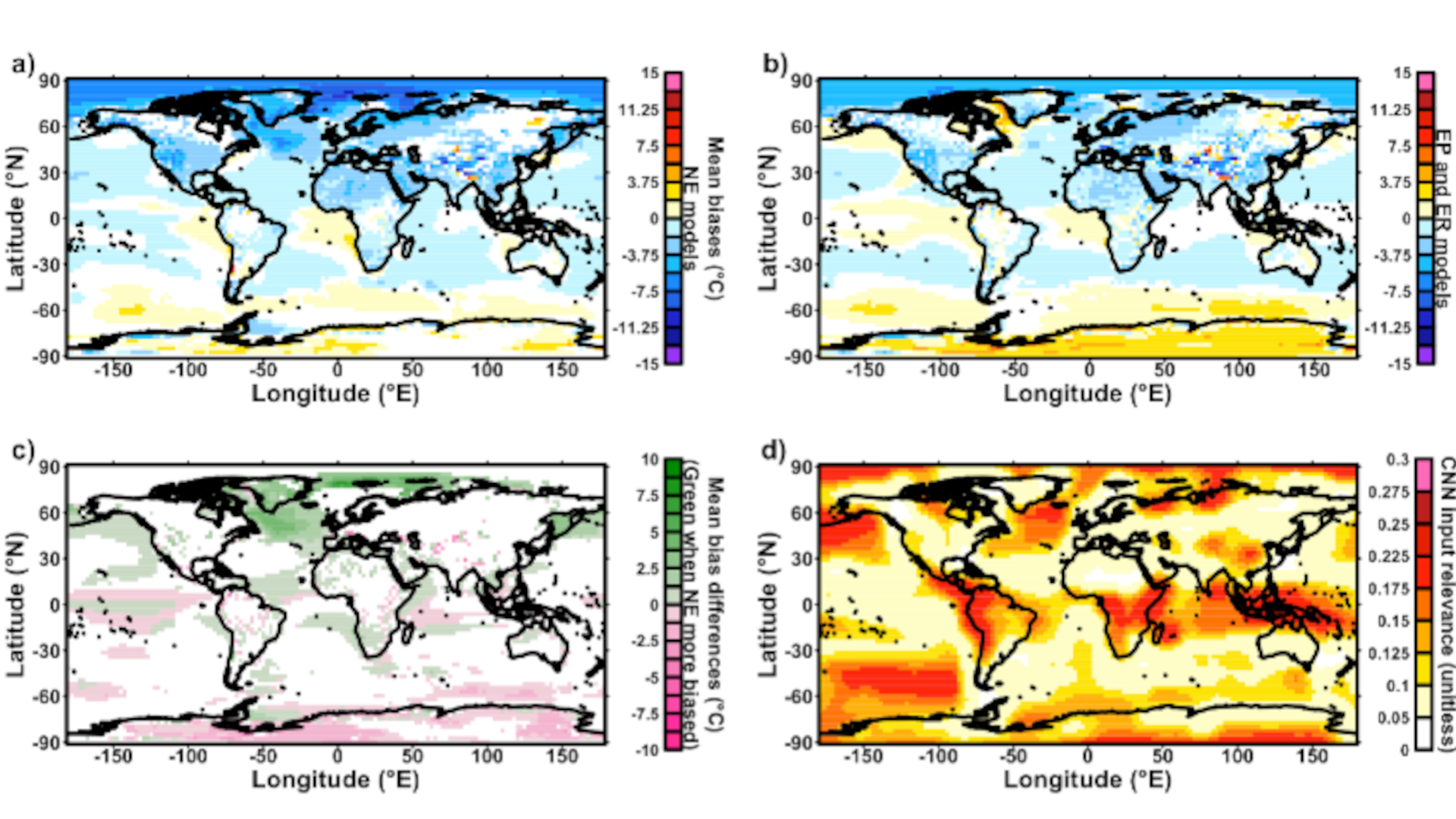
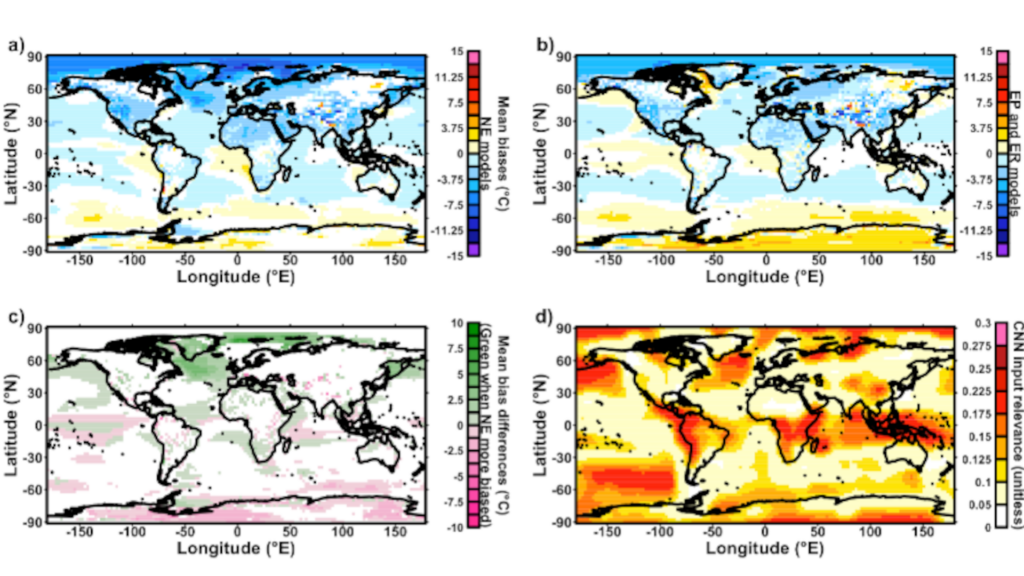
inimizing climate model biases is essential to reduce uncertainties in future climate projections. Despite recent advances, improvements between generations of Earth System Models (ESMs) remain modest, largely due to continued reliance on subgrid-scale parametrizations. These are required because CMIP6 model resolutions are too coarse to explicitly simulate small-scale processes such as ocean mesoscale eddies and deep atmospheric convection, which strongly influence climate patterns. Recent gains in computational power have enabled higher-resolution ESMs that can resolve some of these processes, thereby reducing the need for parametrization. However, robustly detecting improved modeling with increased resolution remains challenging due to internal variability and model-to-model discrepancies. This study employs a convolutional neural network (CNN) classifier combined with explainable AI (XAI) to assess the role of resolution in simulating winter surface temperature fields in an ensemble of 17 control climate simulations with varying oceanic and atmospheric resolutions. The CNN distinguishes between ESMs of varying resolutions using temperature snapshots, while XAI identifies the regions driving these classifications, offering deeper insight into ESM behavior. The results show that ESMs with similar ocean grid resolutions are more often confused with each other by the CNN than those from different modeling centers, highlighting the central role of ocean resolution, particularly mesoscale eddies, in shaping climate simulations. Although limited to surface air temperature, the approach provides a more nuanced perspective on ESM differences and performance than traditional bias analyses. The framework can be extended to other variables and ESM features, offering a powerful tool for ESM intercomparison and evaluation.