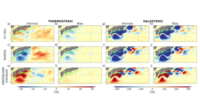
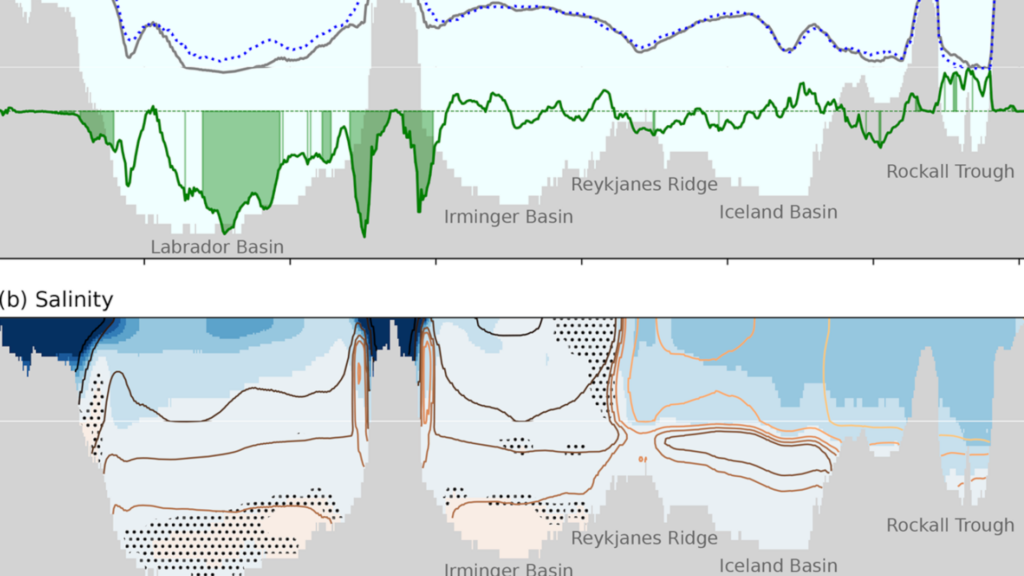
The vast majority of studies examining the impact of freshwater from ice sheet melting on the Atlantic Meridional Overturning Circulation (AMOC) use climate models that cannot resolve mesoscale ocean processes and do not include an accurate spatio-temporal distribution of the freshwater forcing. These two factors critically affect the nature of the AMOC response. Our study partially fills that gap with a set of three hosing experiments using perpetual 1950 radiative forcing with the global configuration of the eddy-rich EC-Earth3P-VHR climate model. The model is forced for 21 years with a spatial and monthly distribution of Greenland meltwater fluxes derived from a product based on observations and model simulations. An annual average close to 0.04 Sv is released on top of the simulated model river runoff, which is vertically distributed in the coastal points connected to each hydrological basin.
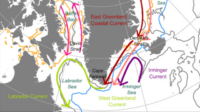
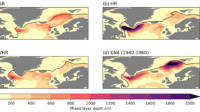
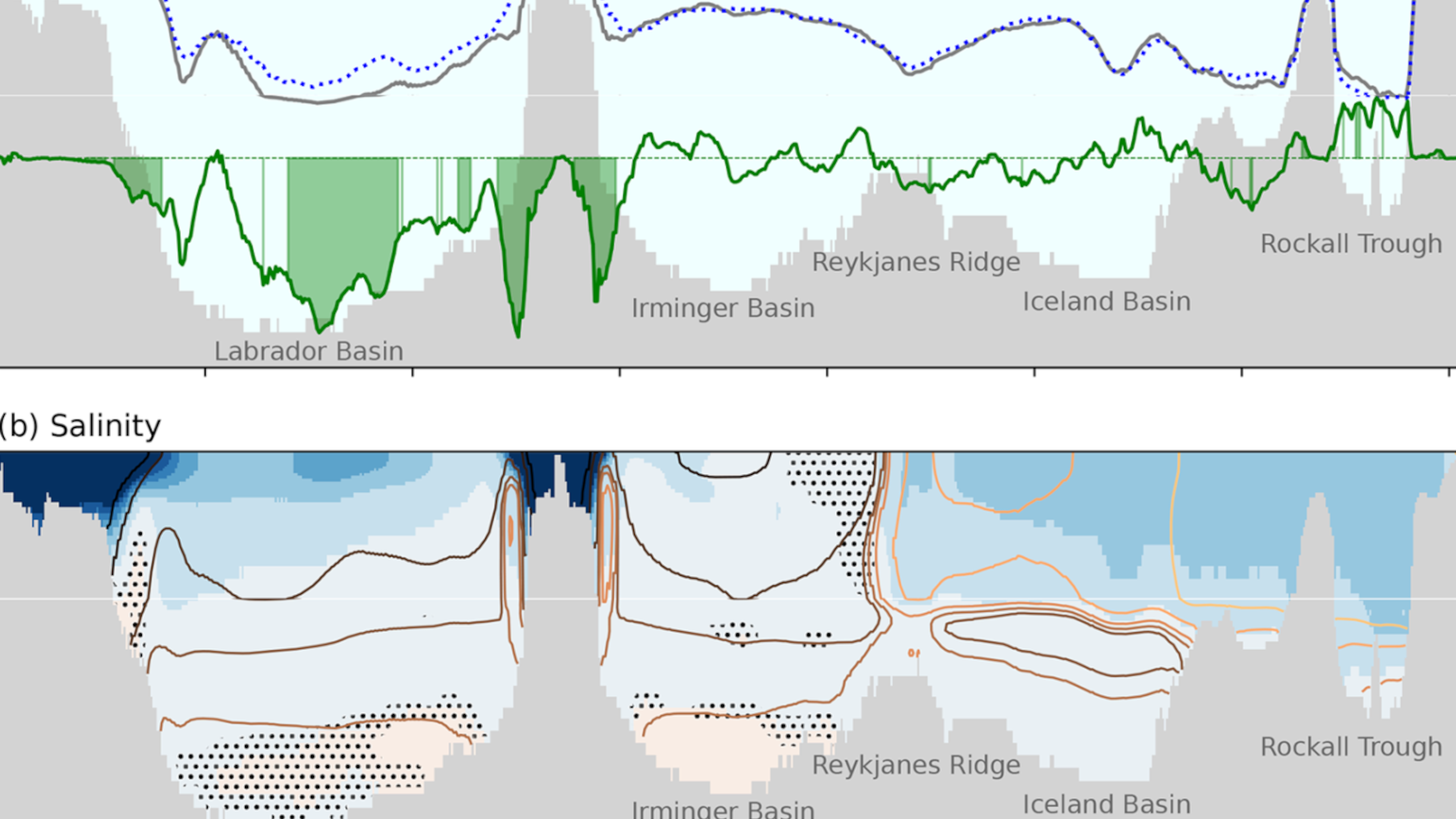
Within the first year, we observe a response of reduced salinity in the Greenland and Labrador currents. Since the beginning of the experiments, these boundary currents also experience an acceleration and cooling. The cooling arises because freshwater-induced stratification suppresses vertical mixing, reducing the entrainment of warmer subsurface waters into the surface layer of the boundary currents. The meltwater fluxes also lead to a rapid weakening of the AMOC at subpolar latitudes due to circulation adjustments forced by the changes in density gradients, with the salinity-driven density reduction outweighing the temperature-driven density increase. Around year 7, deep mixing in the Labrador Sea begins to weaken as freshwater anomalies accumulate through lateral exchanges with the boundary currents. This weakening in deep mixing affects the Deep Western Boundary Current (DWBC), which warms up at the OSNAP section, and sequentially further weakens the AMOC, resulting in an even stronger reduction that reaches also the subtropical latitudes. After the 21 simulated years, the AMOC has weakened by almost 3 Sv at 60.2° N in density space, which represents a ∼20 % reduction of the climatological value in the control, 14.9 Sv. In the context of the North Atlantic, a basin-wide decrease of 1.3 Sv is measured between 10–65° N, which represents about 10 % reduction of the control reference, 13 Sv. This AMOC reduction is strong enough for some global climate impacts to emerge, such as a “bipolar seesaw” temperature response.