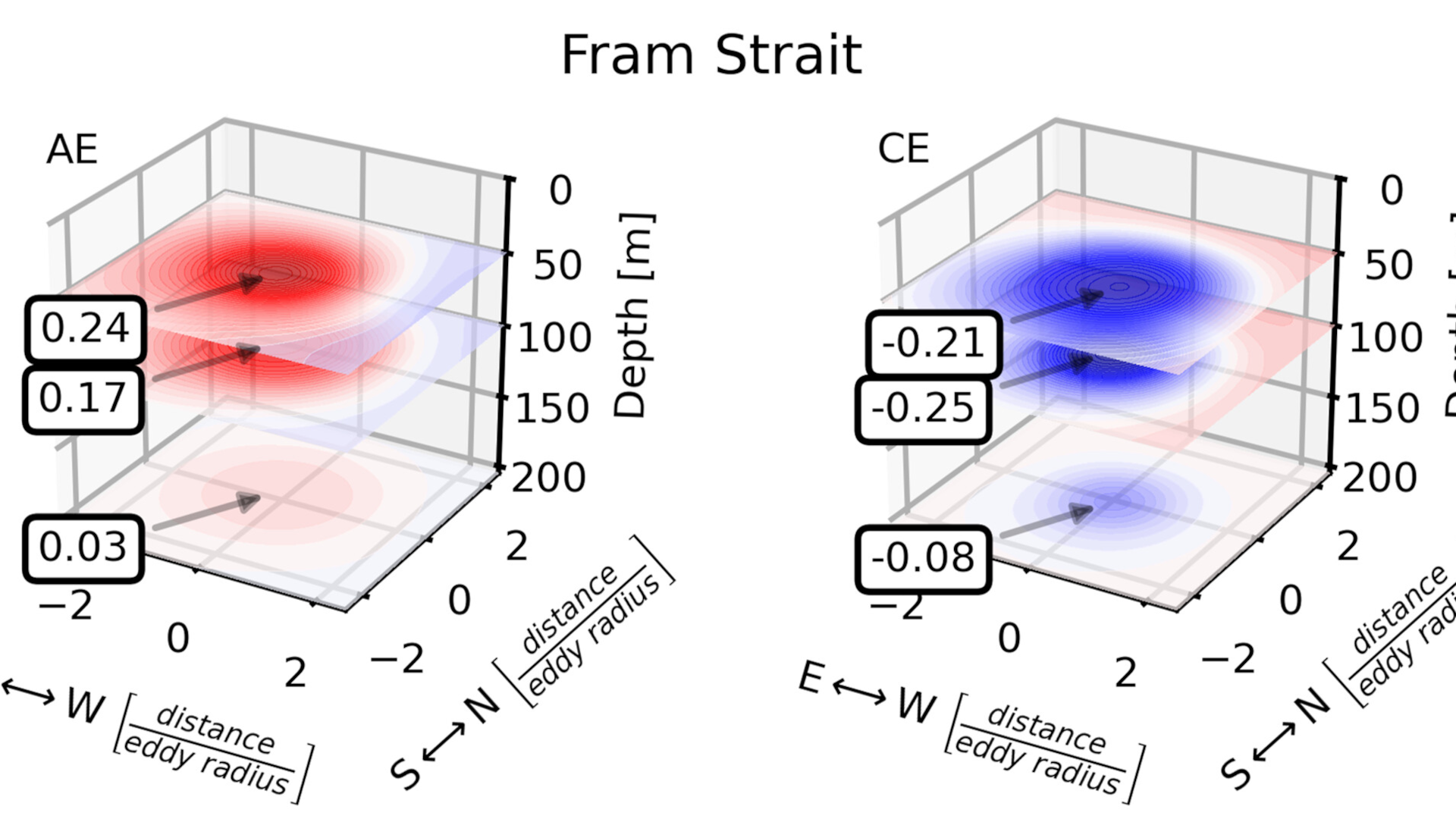
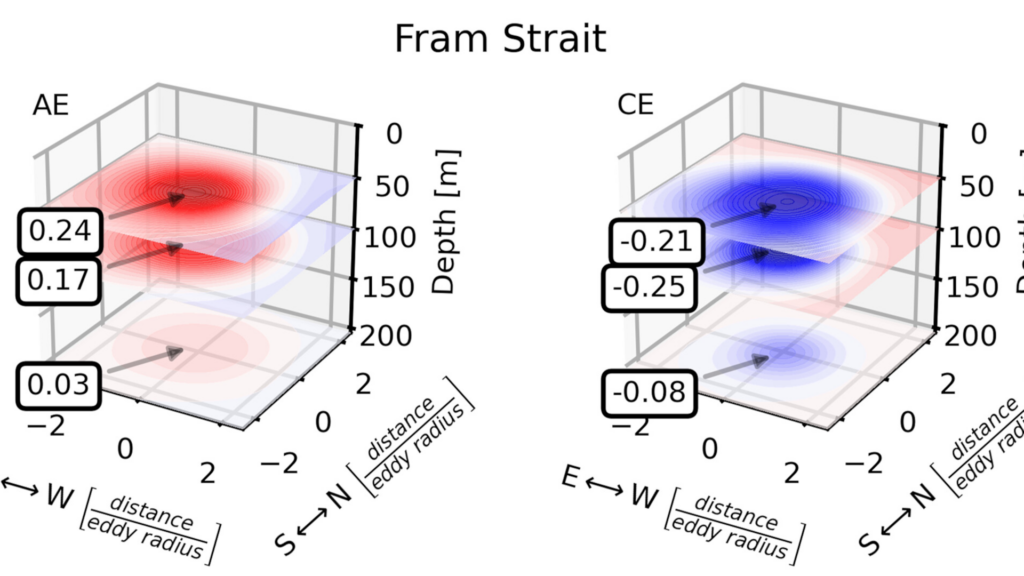
Mesoscale eddies are abundant features in the Arctic Ocean, influencing ocean dynamics and stratification, transporting heat, salt, and nutrients, and modulating sea ice melting. In this study, we detect and track coherent eddies in an ocean simulation at 1 km resolution using the unstructured-mesh Finite volumE Sea ice-Ocean Model (FESOM2). Detected eddies are characterized by their properties and their spatial and seasonal variability. We then use quasi-3D composites of eddy-induced anomalies to assess their effect on the water column and sea ice. Eddy generation is concentrated along topographic features and the boundary current, with eddy sizes scaling with the local Rossby radius. Anticyclonic eddies (AE) are consistently larger and more energetic than cyclonic eddies (CE) and uplift warm, salty Atlantic Water into the upper ocean, driving vertical heat fluxes and inducing localized basal sea ice melt. CE, in contrast, downwell cold surface water and have minimal impact on the surface heat budget. Composite analysis shows that eddy-induced anomalies are strongest in Fram Strait, weakening downstream, and larger under the pack ice than in the marginal ice zone (MIZ). Our results support the presence of an “Eddy-Ice-Pumping” mechanism in which surface stress with sea ice enhances vertical transports and accelerates eddy decay. Our findings highlight the active role of mesoscale eddies in vertical exchange and Atlantification processes in the Eurasian Arctic, and highlight the value of high-resolution models for interpreting observations and future changes.