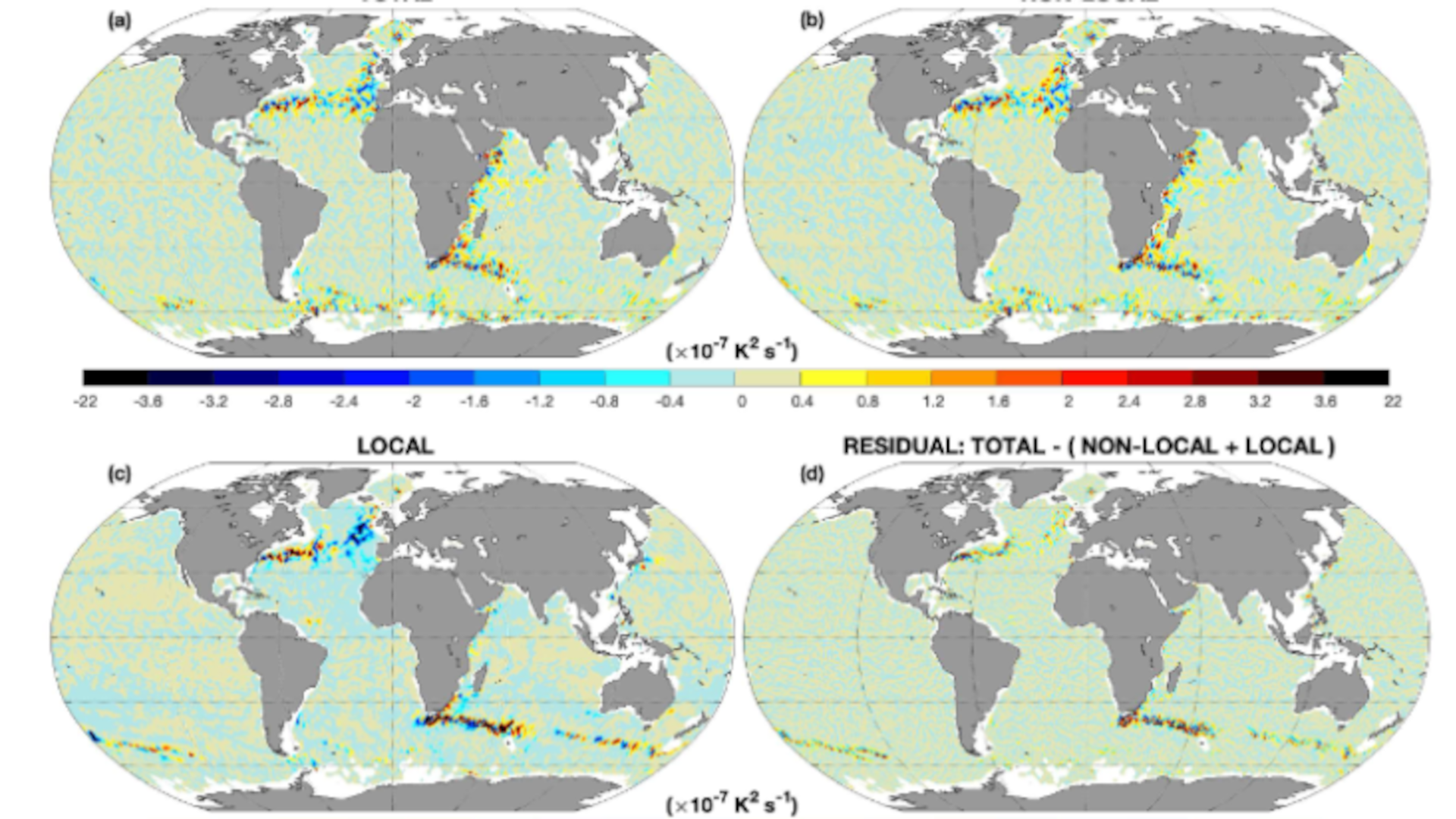
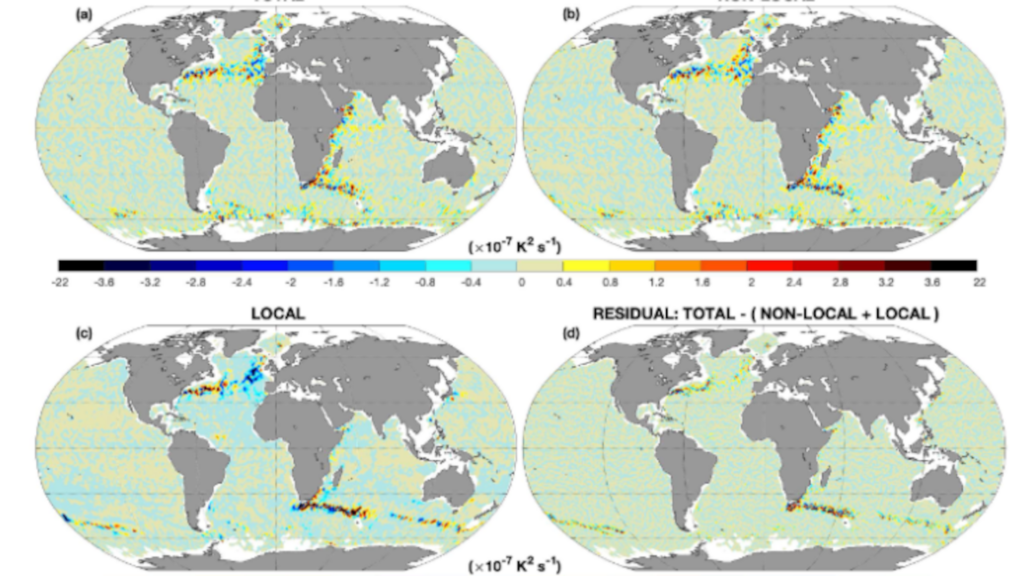
Ocean eddies are ubiquitous in the ocean. Characterizing and quantifying their impact on the large-scale ocean circulation is key. Here we compute eddy-mean interactions for Conservative Temperature variance, including temperature variance transfers. This is done using the ANDRO dataset, which records mean temperature and horizontal displacement of Argo floats during their journey at parking depth (~1 000 m). The analysis does not show any consistency between the sign of the turbulent heat flux and the slope of the mean isotherms, questioning the validity of traditional downgradient flux turbulent closure in the context of temperature variance budget. The temperature variance interactions suggest the dominance of the non-local, redistribution term over the local, transfer term. They both have typical spatial scales ranging from 200 km to 1 000 km. When averaged over large regions, transfers are from the mean to the turbulence, but the North West Atlantic remains a unique region which acts as a turbulence graveyard. Within a water mass framework, transfers are quite consistently shrinking the mean temperature distribution except for a few extreme Water Masses: the Arctic Intermediate Water, the Antarctic Bottom Water, and the Red Sea - Persian Gulf Intermediate Water. This is also the case for a subset of the Mediterranean Water. However the Mediterranean Water is the main location of the broadening of the mean temperature distribution. These results provide observational evidence of the action of the turbulence on the mean temperature structure that could be tested in numerical ocean and climate models for validation and for the development and the implementation of ocean turbulent closures.