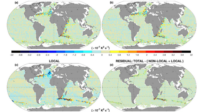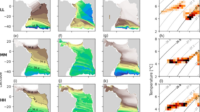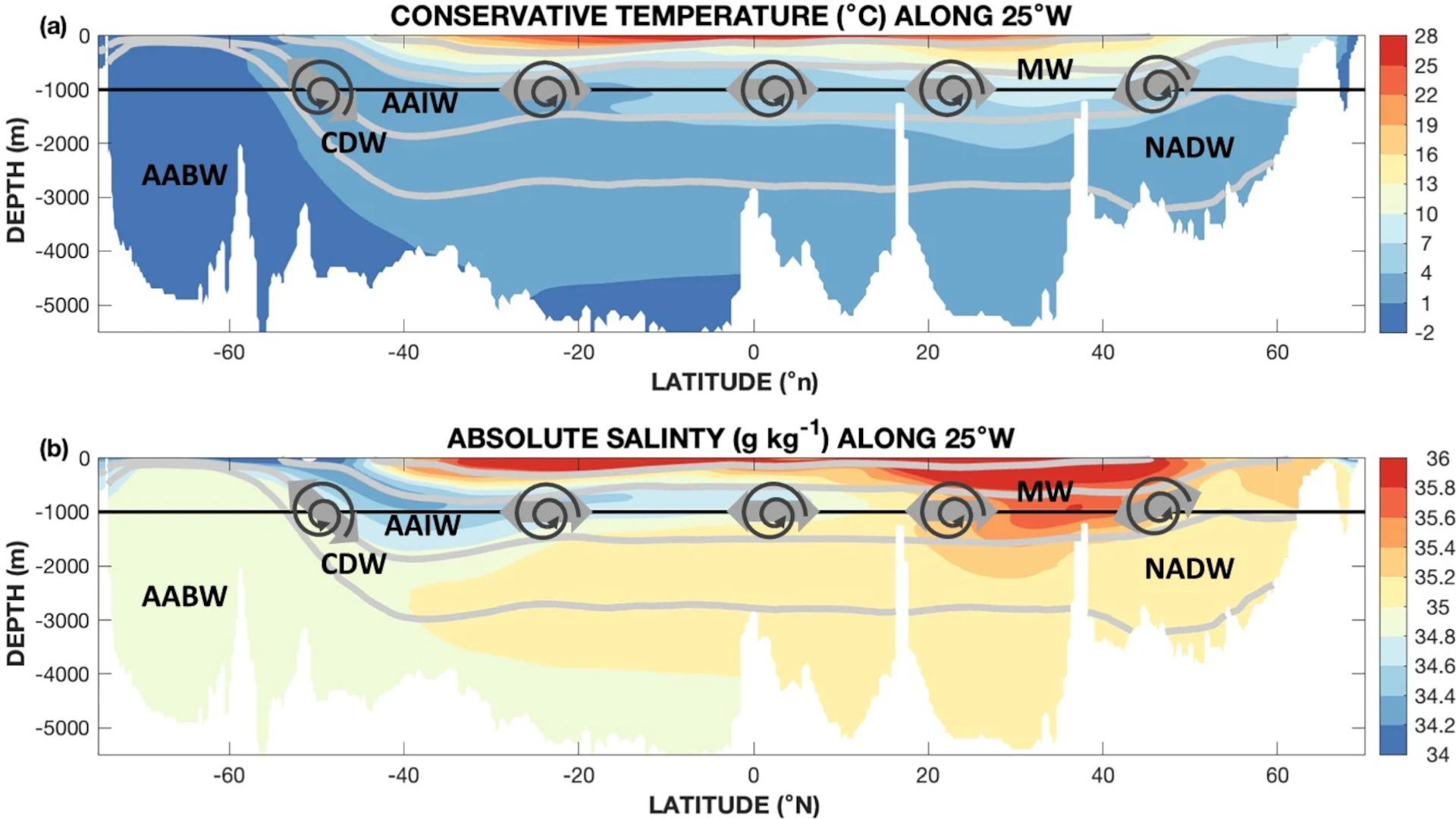
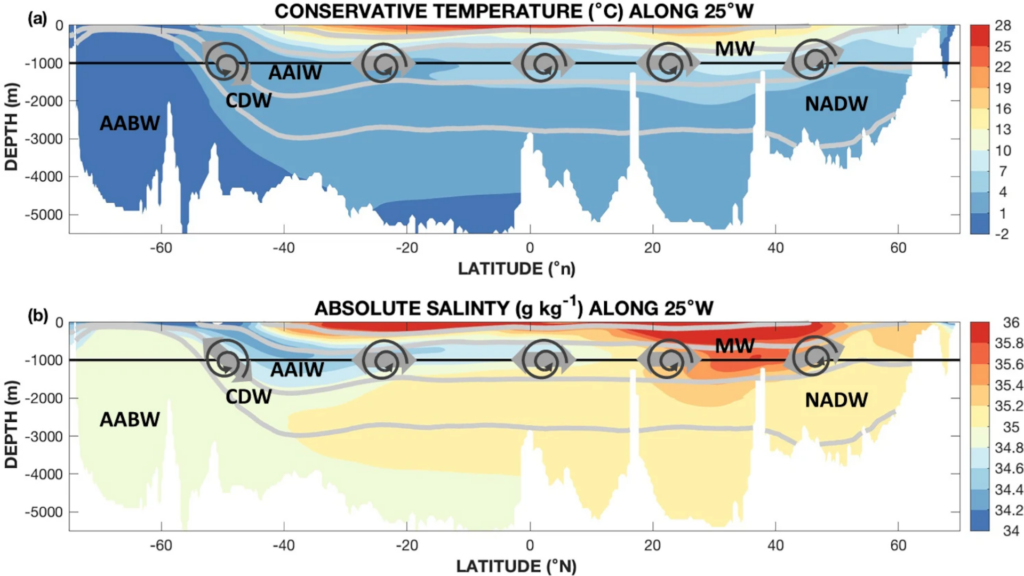
The ocean, because of its ability to store heat and as the biggest mediator of water exchanges on Earth, modulates the climate from years to centuries. By combining Water Mass transformation and the Temporal-Residual-Mean frameworks, together with a direct estimation of turbulent diffusivity (computed through an artificial intelligence method), we determine temperature and salinity transformations along density surfaces. Because isopycnal transformations barely alter the density field, they remain hidden from the ocean dynamics. Here we unveil these hidden, isopycnal transformations from in situ observations at 1000-m depth. We show that these isopycnal transformations are 5 times as large as their diapycnal counterpart and are occurring for ~ 67% in the Southern Ocean. Our estimations stress the role of the spatially-varying and anisotropic characteristics of isopycnal diffusion, often not considered in ocean models. This has major consequences for our understanding of the role of the ocean in response to anthropogenic climate changes.