Overview
EERIE simulations follow established CMIP6 protocols while evolving toward a more flexible, ensemble-based strategy to better address key scientific questions and computational Constraints.
Phase 1: CMIP6-based simulations
High-resolution coupled simulations (HighResMIP)
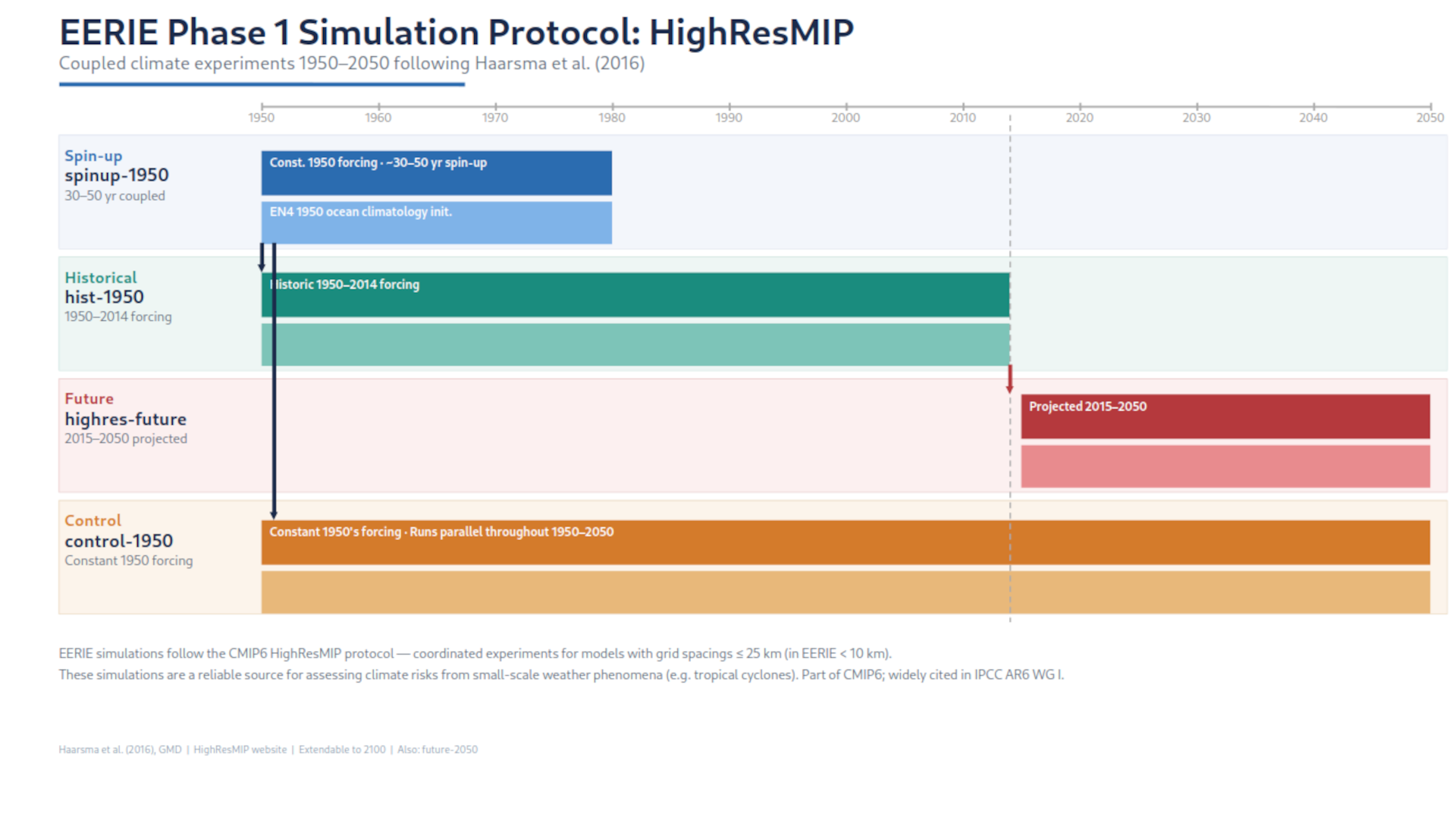
Phase 1 high-resolution coupled simulations following the CMIP6 HighResMIP protocol, covering 1950–2050 with historical and projected forcing, alongside control simulations with constant 1950 forcing.
Phase 1 simulations follow the CMIP6 HighResMIP protocol:
- coupled atmosphere–ocean simulations from 1950 to ~2050,
- historical forcing (1950–2014) and projected forcing (2015–2050),
- complemented by control simulations with constant 1950 forcing,
- initialized from multi-decadal coupled spin-up integrations.
These simulations provide a consistent framework to assess how increasing resolution improves the representation of weather systems and extremes.
Long-term simulations (CMIP6 DECK)
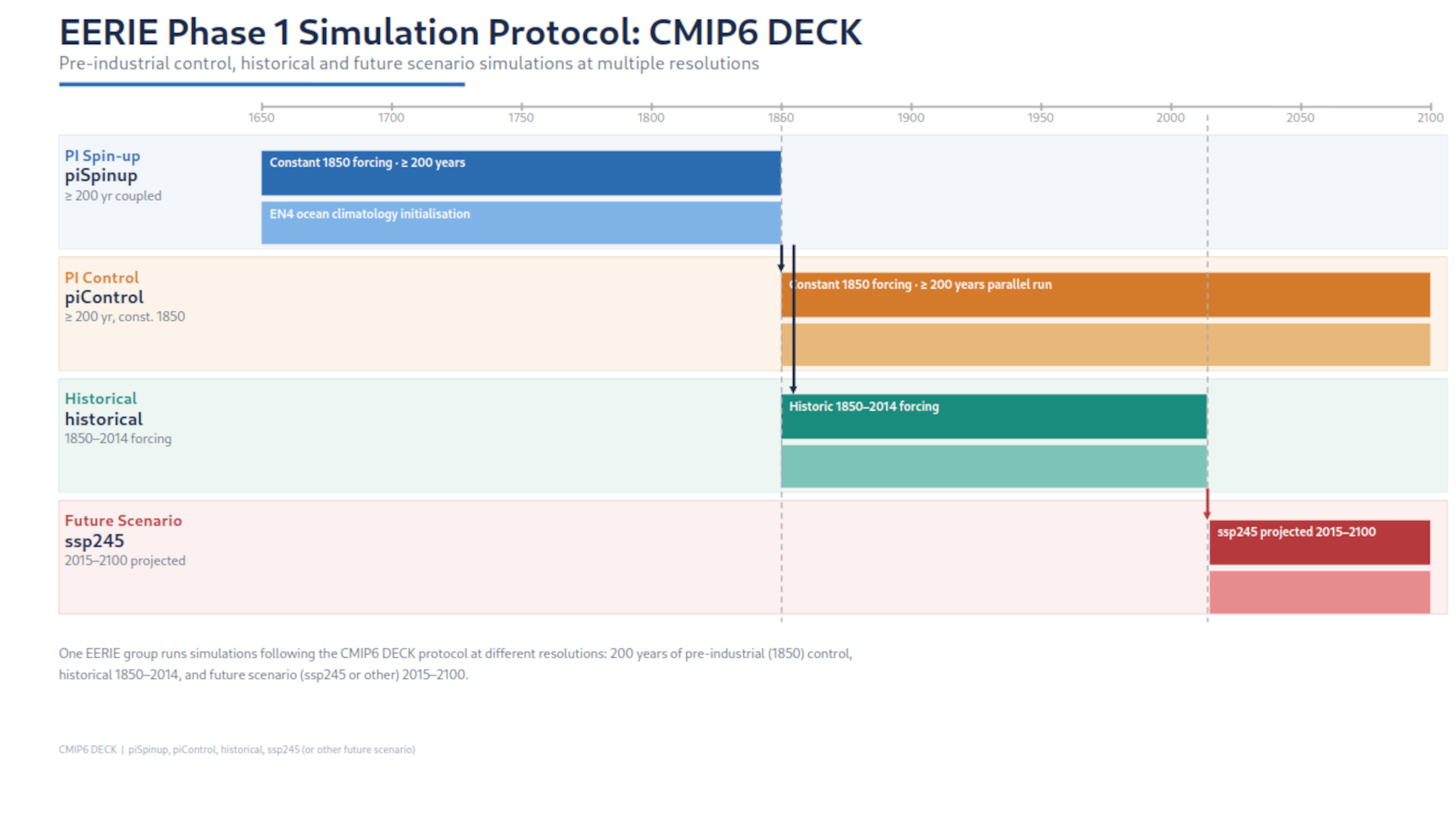
Phase 1 long-term simulations following the CMIP6 DECK protocol, including pre-industrial control, historical, and future scenario simulations.
In addition, EERIE performs simulations following the CMIP6 DECK protocol:
- multi-century pre-industrial control simulations
- historical simulations (1850–2014)
- future scenario simulations (e.g. SSP2-4.5 to 2100).
These simulations provide the long-term context needed to assess climate variability and forced change.
Phase 2: Revised simulation strategy
From long integrations to targeted experiments
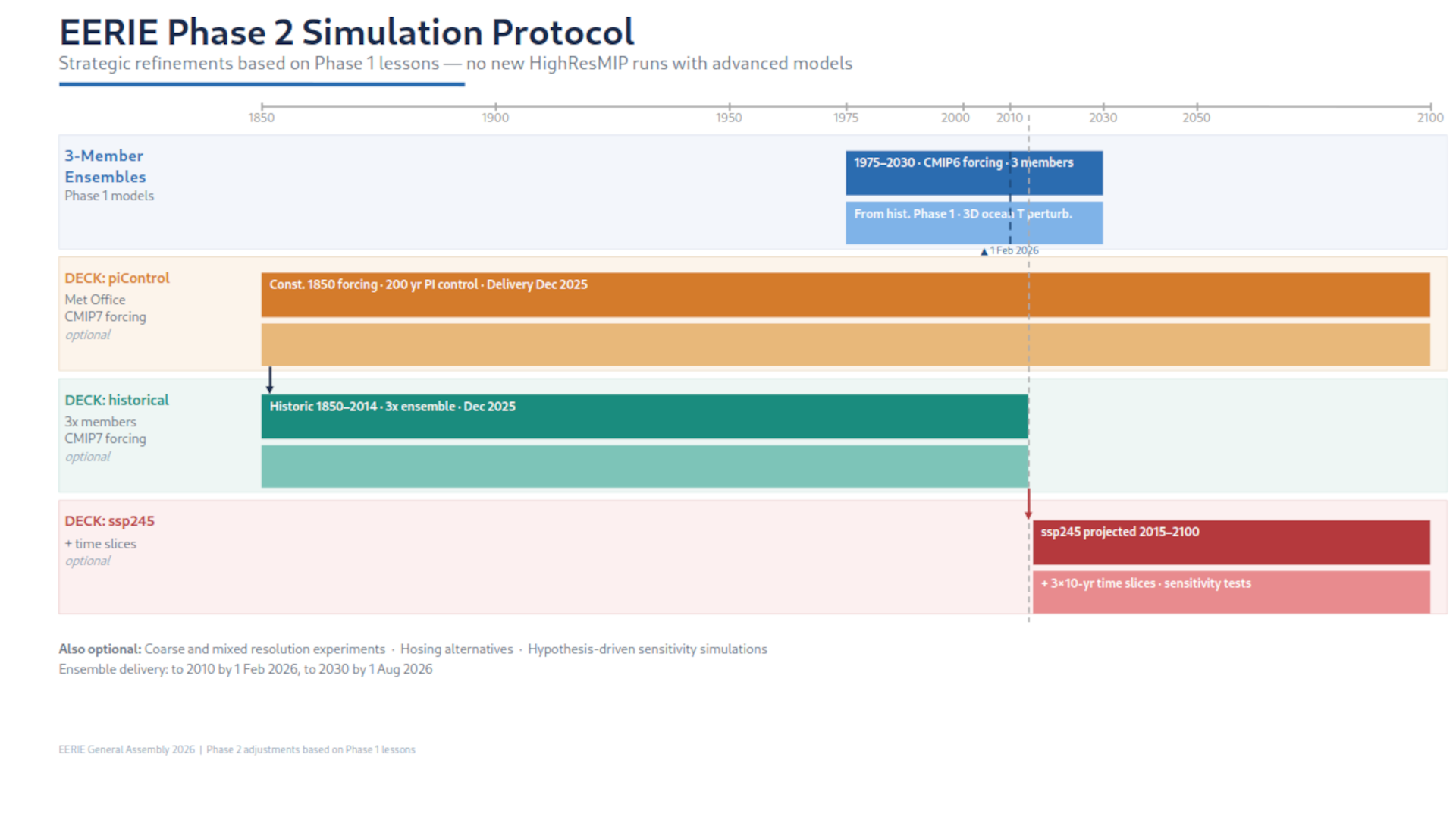
Revised Phase 2 simulation strategy focusing on ensembles, time slices, and targeted sensitivity experiments, based on lessons learned in Phase 1.
Based on insights from Phase 1, EERIE has refined its simulation strategy.
Phase 2 focuses on:
- small ensembles (typically 3 members) covering ~1975–2030 to quantify model uncertainty
- time-slice experiments to test model developments
- targeted DECK simulations with optional CMIP7 forcing
- hypothesis-driven sensitivity experiments.
This shift enables:
- faster delivery of results
- improved quantification of uncertainty
- more efficient use of high-performance computing resources